Feature essay
The Missing Control Plane Above vLLM
Serving a model is a workload. Operating it as a service is a platform.
There is a point in every self-hosted LLM project where the demo starts to look finished.
The model answers. The endpoint speaks OpenAI. The GPU is alive. Grafana has a few panels. Someone types a prompt, gets tokens back, and the room relaxes a little.
That is the dangerous moment.
Because vLLM running in a pod is not the platform. It is the engine. A very good engine, but still only the part that turns requests into tokens. The platform begins around it, in the layer that answers the questions the model server does not even know exist.
Who is allowed to call this? Which model aliases can they see? What happens when they hit a budget? Which replica should get this request? Is the GPU actually overloaded, or just busy? Where did the secret come from? Can this stack move to another cloud without pretending GPUs are portable in a way they are not?
Those are not afterthoughts. Those are the control plane.
I learned this while building Kubernetes LLM Inference Platform, a GitOps-managed LLM inference platform on Kubernetes, now open source: vLLM and KServe for serving, LiteLLM for the tenant edge, Gateway API Inference Extension for routing, Kueue and KEDA for scheduling and autoscaling, External Secrets for secret delivery, Prometheus/Grafana/DCGM for observability, and OpenTofu underneath for the cloud substrate.
The interesting part was not wiring those names together. The interesting part was deciding where each responsibility stops.
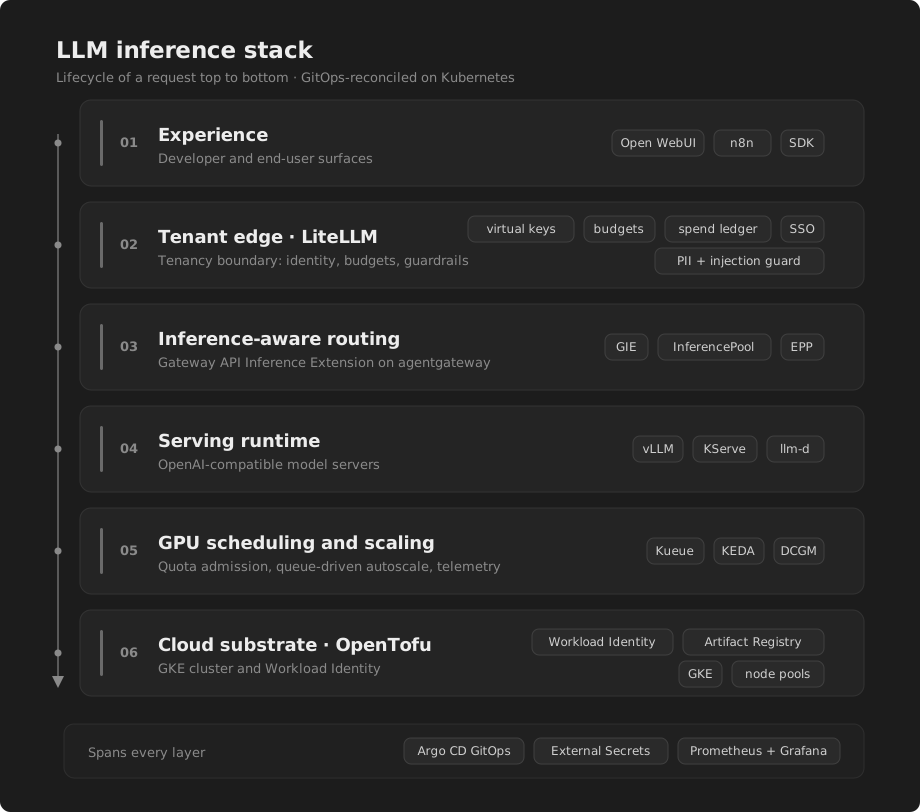
This is a claim about the shape of the platform: which boundaries have to exist before a model endpoint becomes something other people can use without inheriting your mental state.
Two Gateways, Two Questions
The first trap is thinking “AI gateway” is one layer.
It is not. At least not if you want the system to behave like a service rather than a demo.
LiteLLM and Gateway API Inference Extension look like they live in the same neighborhood, but they answer different questions:
- LiteLLM asks the business question: who is this, what key are they using, which model alias do they want, what are they allowed to spend, and what should be written to the ledger?
- GIE asks the serving question: of the replicas that can serve this model, which one has the healthiest queue and cache state right now?
Those should not be collapsed.
LiteLLM belongs at the tenant edge. It is where virtual keys, per-key budgets, model allowlists, rate limits, and spend records live. It turns a raw model endpoint into something you can safely hand to another person.
GIE belongs behind that, facing the serving pool. It should not care who the tenant is. It should care which replica has headroom.
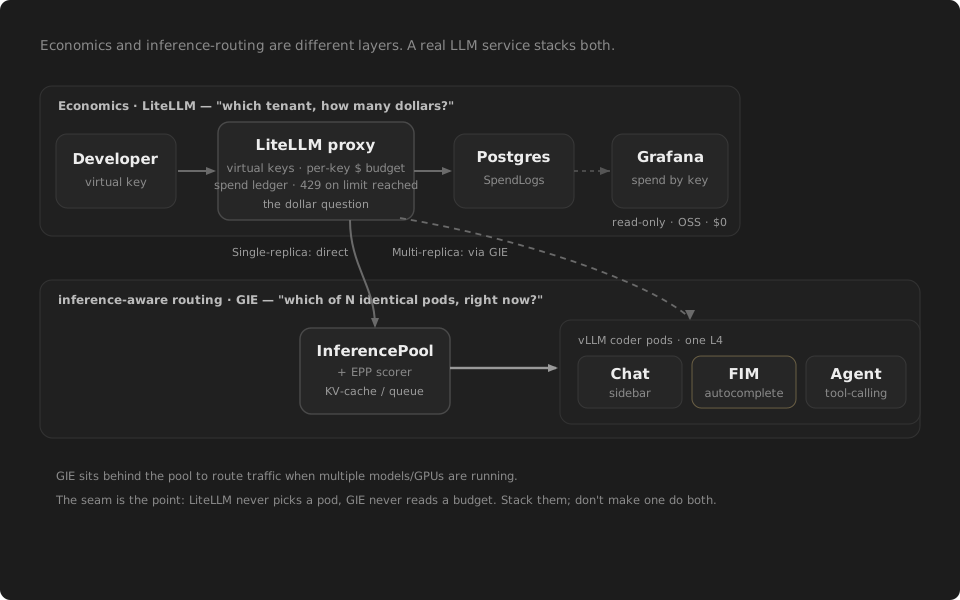
That boundary matters because it prevents architectural mush. If a developer has a $5 monthly key, that is not a Kubernetes scheduling concept. If one vLLM pod has a longer queue than another, that is not a billing concept.
The platform needs both answers. It just should not ask the same component to invent both.
The GPU Graph Lies Before It Helps
The second trap is believing the first dashboard you open.
During a benchmark on one L4 running Qwen2.5-0.5B-Instruct on
vLLM, the GPU graph went to 100 percent. That sounds like saturation. It is also not enough information to make a scaling decision.
The rest of the run looked like this:
| Signal | Peak |
|---|---|
GPU utilization (DCGM_FI_DEV_GPU_UTIL) | 100% |
KV-cache usage (vllm:kv_cache_usage_perc) | 1.1% |
Requests running / waiting (vllm:num_requests_*) | 31 / 0 |
Read those together. The GPU was busy. The KV cache was basically empty. Nothing was waiting.
That is not the same thing as “the service is drowning.” It means this small model kept the GPU active while the engine still kept up with demand. If I had scaled on GPU utilization, I would have scaled on noise.
The useful signal was queue depth: vllm:num_requests_waiting.
That is the moment the system says, “I am falling behind.” It is the signal KEDA should care about. It is also the signal an inference-aware router should consider when spreading traffic across replicas. GPU utilization tells you work is happening. Queue depth tells you work is not keeping up.
This is not a universal law that GPU utilization is useless. It is a narrower and more useful claim: for this vLLM workload, under continuous batching, raw GPU utilization stopped carrying enough information to drive autoscaling. The platform had to scale on the serving signal, not the hardware vibe.
That distinction is where a platform becomes more than a deployment.
Portability Lives Below The Pretty Diagram
“Cloud-independent” is another phrase that can get sloppy fast.
The in-cluster platform can be portable. The GPU substrate is where that claim gets tested.
On GKE, I started with the instinct many Kubernetes people have: install the NVIDIA GPU Operator and own the GPU stack from inside the cluster. It felt more portable. Same operator everywhere, same manifests everywhere.
In practice, it fought the platform.
GKE already manages the driver, device plugin, container runtime integration, and DCGM exporter. The driver path could look alive while the runtime integration still failed in the place that mattered: GPU pods could not actually schedule and run correctly. Owning that layer from inside Kubernetes was not portability. It was ignoring the substrate boundary.
The better split was blunt:
- OpenTofu owns the substrate: cluster, node pools, IAM, Workload Identity, Artifact Registry, GPU node configuration.
- Argo CD owns the in-cluster platform: controllers, gateways, serving workloads, dashboards, External Secrets, feature-gated apps.
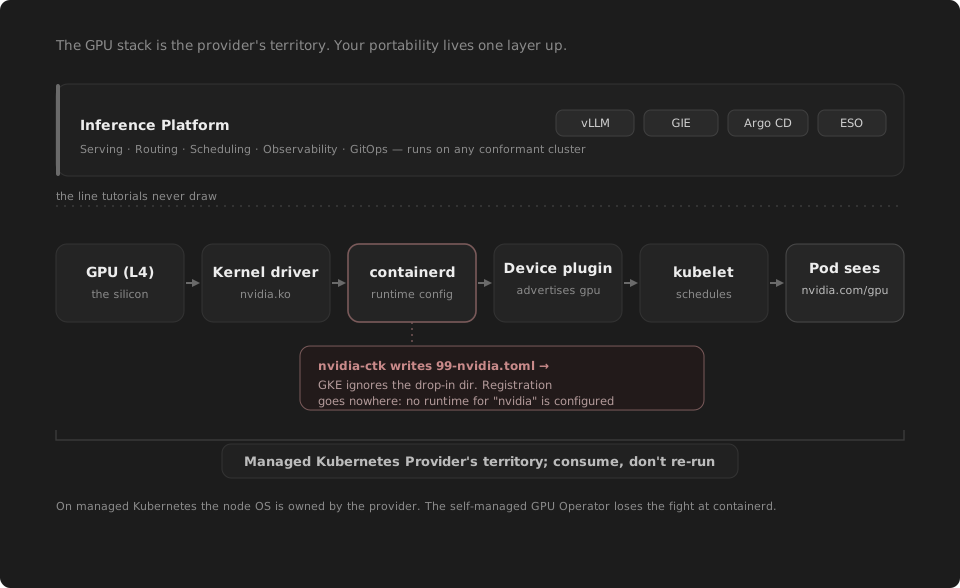
That makes the portability claim smaller, but true. The platform is cloud-independent above the substrate. Moving clouds means re-solving GPU drivers, storage classes, load balancing, and the secret trust root. It should not mean rewriting the tenant edge, serving layer, routing layer, or observability model.
The second-cloud proof reinforced that. On Hetzner, there is no managed GKE GPU stack to consume, so the NVIDIA GPU Operator becomes the right substrate path. Same platform idea, different substrate answer.
That is the part worth saying plainly: portability is not pretending the substrate does not exist. Portability is making the substrate the only thing that has to change.
The Service Is The Ledger
The moment another person uses your model, “it returns tokens” stops being the bar.
A service needs an accounting surface.
For this stack, that surface is LiteLLM: virtual keys, model allowlists, per-key budgets, budget windows, rate limits, and spend logs. The model server does not need to know any of this. The user does.
A key for a chat front-end can see coder-chat, coder-fim, and embeddings. A key for an
autocomplete server can see only coder-fim and embeddings. Both can have dollar budgets. Both
write spend records.
The non-obvious bit: self-hosted models have no default price. If you do not set
input_cost_per_token and output_cost_per_token, every call costs zero and the budget system is
theater. Once pricing is explicit, the platform can answer the question a service must answer:
“who spent what?”
I like the database ledger for this more than metrics alone. Metrics are great for operations. Ledgers are great for money. LiteLLM already writes request spend into Postgres, so Grafana can read that table through a read-only datasource and show spend by key, model, and budget window.
That dashboard is not decoration. It is the difference between “we have a model endpoint” and “we can hand someone a key and know what happens next.”
Secrets Are Not Plumbing
Secrets are where platform demos quietly become bad examples.
This platform has secret material everywhere: LiteLLM master keys, generated virtual keys, database credentials, OAuth values, DNS tokens, registry credentials, and provider tokens. The rule is simple: secret values do not enter git, and they do not enter IaC state.
Git stores the contract. External Secrets materializes runtime Kubernetes Secrets from the selected backend. On GKE that backend is GCP Secret Manager through Workload Identity. Off GKE, the backend can change, but the in-cluster contract stays stable.
That is not the sexiest part of the system. It is also exactly the kind of line a platform has to draw early, because retrofitting secret hygiene after people depend on the stack is miserable.
Complexity Has To Earn Its Keep
The same rule applies to serving layers.
Raw vLLM is the right starting point when you want control and a small blast radius. It is just a Deployment, Service, PVC, probes, and routing. You own the lifecycle because the lifecycle is still simple.
KServe starts to earn its keep when the lifecycle itself becomes the problem: stable per-model URLs, declarative revisions, canaries, scale-to-zero, and one CRD contract across many models.
llm-d is later again. It belongs near the point where serving architecture changes: disaggregated prefill/decode, larger models, more GPUs, and more serious routing pressure.
The easy mistake is to adopt the fanciest serving abstraction first and call that maturity. It is usually just prepaid complexity.
The platform decision is not “which tool is most powerful?” It is “which responsibility has become real enough to deserve a control plane?”
What the Control Plane Owns
After building this, I would describe the platform less by its component list and more by the questions it can answer:
| Question | Platform responsibility |
|---|---|
| Who is calling? | Virtual keys, SSO, model allowlists |
| What can they spend? | Budgets, token pricing, spend ledger |
| What content is allowed? | Tenant-edge guardrails: PII masking, prompt-injection blocking |
| Where should this request go? | Inference-aware routing, queue/cache signals |
| When should capacity change? | Queue-depth autoscaling, not raw GPU utilization |
| Which layer owns the GPU stack? | Substrate-specific IaC, not generic in-cluster wishful thinking |
| How do secrets arrive? | External secret contract, no values in git or IaC state |
| What is actually happening? | vLLM metrics, DCGM, Prometheus, Grafana, cost views |
| Which serving layer is worth it? | Raw vLLM first, KServe/llm-d when lifecycle or scale requires them |
That is the missing control plane above vLLM.
Not a dashboard. Not a wrapper. Not a pile of YAML around a model server.
A set of explicit ownership boundaries.
The model server should be excellent at serving tokens. The platform around it should be excellent at everything that makes those tokens safe, observable, routable, budgeted, and operable by someone other than the person who built the first demo.
Serving a model is a workload.
Operating it as a service is a platform.
The missing control plane is open source.
Kubernetes LLM Inference Platform is
the stack these boundaries come from; fork it, render config.yaml into git, and serve an
authenticated, OpenAI-compatible endpoint on GPU.